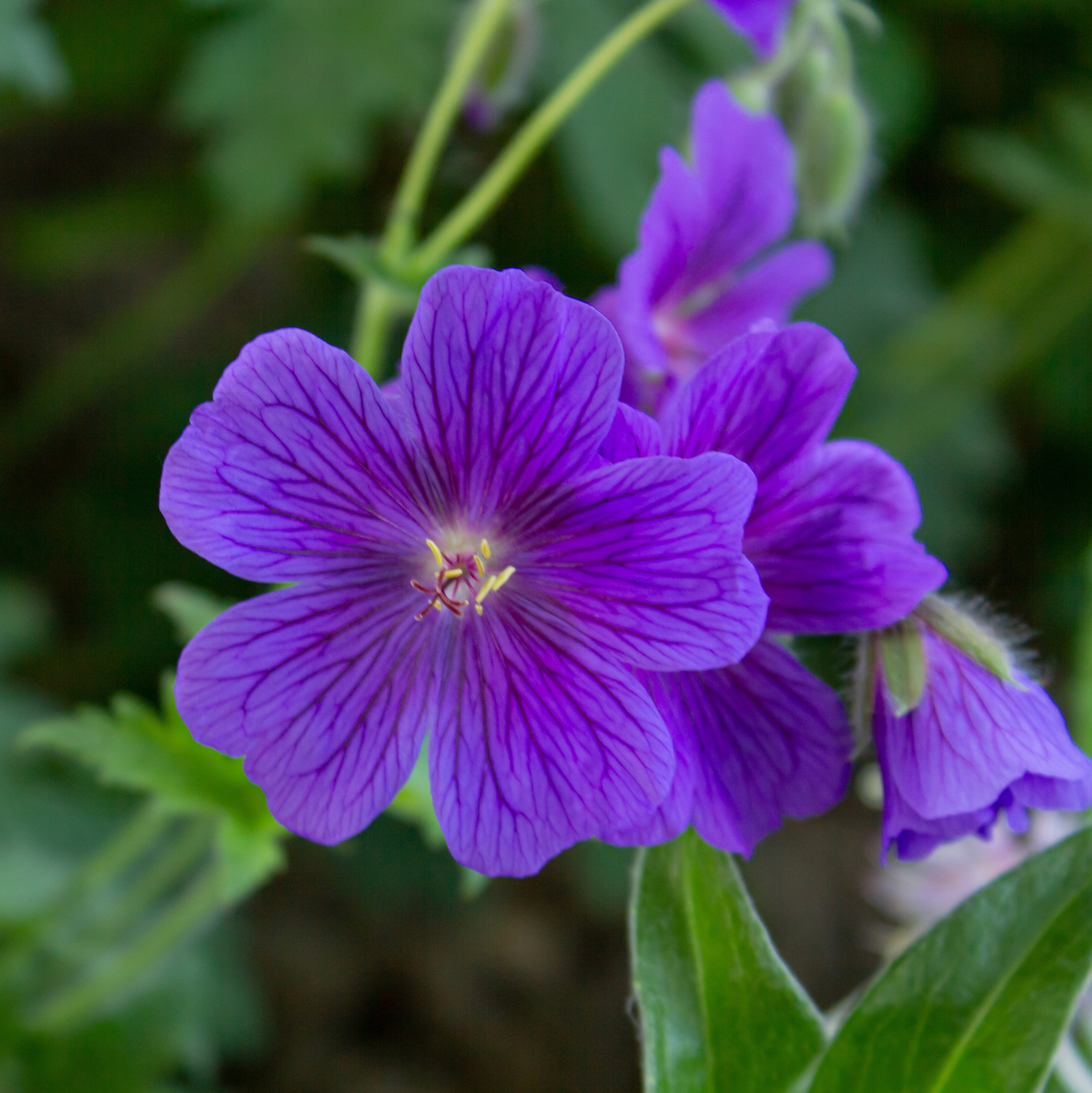
True geraniums, commonly known as hardy geraniums or cranesbills, are dependable garden perennials valued for their attractive flowers, often decorative foliage and ability to thrive in a wide range of garden conditions. They are particularly useful in borders, cottage gardens and as ground cover beneath shrubs and roses.
Unlike the frost-tender pelargoniums commonly sold as bedding geraniums, true geraniums are generally hardy and can remain outdoors throughout the British winter. They range from compact, low-growing plants to vigorous, spreading varieties, offering plenty of choice for different garden situations.
When Do Geraniums Flower?
Most hardy geraniums flower from late spring through summer, although the exact season varies considerably between varieties. Some produce a concentrated display in May and June, while others continue flowering well into autumn.
Their five-petalled flowers appear in shades of blue, violet, purple, pink and white, often with contrasting veins or pale centres.
Popular varieties include:
Geranium ‘Rozanne’: A spreading variety with violet-blue flowers and a long flowering season, often continuing from early summer into autumn.
Geranium sanguineum: Known as bloody cranesbill, this relatively compact species produces pink to magenta flowers and is useful towards the front of borders.
Geranium macrorrhizum: A vigorous, aromatic-leaved species with pink or white flowers in late spring and early summer, particularly useful as ground cover.
Geranium pratense: Meadow cranesbill, an upright species with blue to violet flowers, well suited to naturalistic planting.
How to Grow
Choosing the Right Position
Hardy geraniums vary in their growing habits and preferred conditions. When choosing a plant, check its label for guidance on sunlight, soil conditions and eventual size, as different varieties can have quite different requirements.
Sunlight: Many flower best in full sun or partial shade. Some tolerate considerable shade, while others prefer more open positions.
Soil: Hardy geraniums generally grow well in reasonably fertile, well-drained soil. Some tolerate heavier or drier soils once established.
Spacing: Allow room for the plant’s mature spread. Vigorous varieties can cover a substantial area and may overwhelm smaller neighbouring plants.
Planting
Hardy geraniums are best planted in spring or autumn, when the soil is moist and temperatures are relatively mild.
Dig a hole approximately as deep as the root ball and wider than the pot. Plant at the same depth as in the pot, firm the soil gently and water thoroughly.
Adding organic matter can improve poor soil, but avoid excessively rich conditions for species that prefer leaner, free-draining ground.
Caring for Established Plants
Water regularly during the first growing season, particularly in dry weather. Once established, many hardy geraniums are reasonably drought-tolerant, although prolonged drought can reduce flowering.
A spring mulch of compost or well-rotted organic matter is usually sufficient. Heavy feeding is rarely necessary and can encourage excessive leafy growth.
Encouraging More Flowers
Some varieties benefit from being cut back after their first flush of flowers. This removes tired foliage, encourages fresh leaves and may produce a second display later in summer.
For example, Geranium ‘Johnson’s Blue’ can respond well to cutting back after flowering. However, not every geranium reliably reblooms, and long-flowering varieties such as ‘Rozanne’ generally need less intervention.
Autumn and Winter Care
Hardy geraniums generally need little winter protection in UK gardens.
Many herbaceous varieties die back naturally as temperatures fall. Dead or untidy growth can be cleared in autumn or left until late winter before fresh growth begins.
Some species, including G. macrorrhizum, retain much of their foliage through mild winters. Avoid cutting these back unnecessarily.
Dividing and Propagation
Hardy geraniums can be propagated in several ways, depending on the variety. Hardy geraniums can grow from seed, with certain varieties self-seeding naturally around the garden. Others spread through creeping roots or rhizomes, gradually forming larger patches.
Established clumps can often be divided in spring or early autumn. Lift the plant carefully, separate healthy rooted sections and replant, watering well afterwards.
Some varieties, including ‘Rozanne’, do not produce seeds. Others may grow from seed, but the new plants might not be identical to the parent.
Common Problems
Hardy geraniums are generally trouble-free when grown in suitable conditions.
Powdery mildew: A white, powdery coating may appear on leaves, particularly during dry weather. Remove badly affected foliage and water during prolonged dry spells.
Slugs and snails: Young spring shoots may occasionally suffer damage, particularly in damp, sheltered gardens.
Poor flowering: Excessive shade, overcrowding or overly rich feeding can reduce flower production in varieties that prefer sunnier conditions.
Why Grow Geranium?
Hardy geraniums offer a particularly useful combination of attractive flowers, varied growth habits and relatively straightforward maintenance. Whether used to soften the edges of a border, fill gaps between shrubs or create flowering ground cover, there is a variety suited to many garden situations.
Visit us in Kington to explore hardy geraniums and other perennials for your garden.
We use cookies to ensure that we give you the best experience on our website. If you continue to use this site we will assume that you are happy with it.