
Open today 9:00 - 17:00
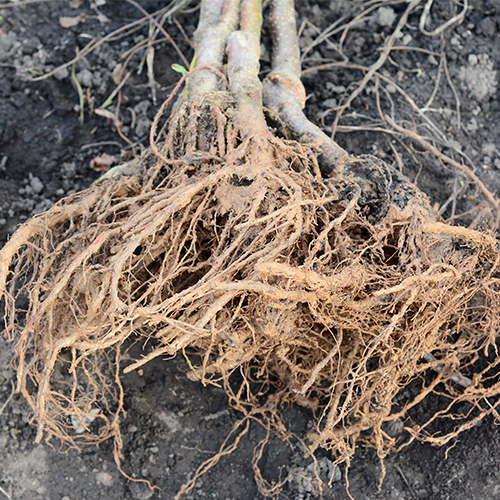
Bare-root plants can look rather different from the plants you usually see for sale in pots. With no container or compost around their roots and, in many cases, no leaves, they can appear surprisingly bare when they arrive.
This is completely normal. Bare-root plants are lifted and sold while dormant, usually between autumn and early spring. Roses, fruit trees, ornamental trees and hedging plants are commonly available this way, and buying bare-root can be an economical option, particularly when you need several plants.
Understanding how bare-root plants are produced, when to buy them and what to do when they arrive will help you decide whether they are the right choice for your garden.
Bare-root plants are plants that have been grown outdoors in nursery fields and lifted from the ground during their dormant period. Instead of being supplied growing in a pot of compost, most of the soil is removed from around their roots before they are sold.
Dormancy makes this possible. During late autumn and winter, many deciduous plants have stopped actively growing and have shed their leaves. Their demand for water is much lower, allowing them to be lifted, transported and replanted with less stress than during active growth.
Once planted and conditions begin to warm in spring, the plant comes back into active growth.
In the UK, the bare-root season generally runs from late autumn through winter and into early spring, although the exact timing varies according to the plant and weather conditions.
This gives gardeners an opportunity to plant trees, fruit, roses and hedging before active growth begins again in spring.
Planting should be postponed if the ground is:
If conditions are unsuitable when your plants arrive, don’t force them into poor ground. Keep the roots protected until conditions improve.
Bare-root stock is available across a much wider range than hedging alone. Depending on the nursery and time of year, you may find:
Not every plant is suitable for bare-root production, and not every variety will be offered this way. Container-grown plants therefore remain important where you need a particular plant or want to buy outside the dormant season.
Bare-root plants are generally less expensive than comparable container-grown plants because they don’t require an individual pot and large volume of growing medium. They are also lighter and take up less space during handling and transport.
The difference becomes particularly noticeable when planting in quantity. If you need dozens of plants for a new hedge, for example, buying bare-root plants can make the project considerably more affordable.
A lower price doesn’t mean a lower-quality plant. It reflects the way the plant has been grown, lifted and supplied.
Bare-root plants aren’t inferior to container-grown plants. They are simply grown and supplied differently, and each option has its advantages.
BARE-ROOT PLANTS
🌱 Available during the dormant season
🌱 Often less expensive
🌱 Particularly useful when planting in quantity
🌱 Roots need protecting until planted
CONTAINER-GROWN PLANTS
🪴 Available throughout more of the year
🪴 Greater flexibility over planting time
🪴 Useful when you want a particular plant or variety
🪴 Can be bought and planted at a wider range of sizes
Neither is necessarily the better choice. Your decision will usually depend on the time of year, availability and how many plants you need.
A dormant bare-root plant won’t necessarily look impressive. Deciduous plants may have no leaves at all, and the roots won’t be surrounded by the familiar ball of compost you see when removing a plant from a pot.
That’s exactly how they should look at this time of year.
A healthy plant should generally have:
Don’t mistake dormancy for a dead plant. Buds may be small and tightly closed throughout winter before beginning to swell as growth starts in spring.
The roots are the part that needs your immediate attention. Without a pot of moist compost around them, exposed roots can dry out relatively quickly.
Unpack the plants promptly and check their condition. Keep the roots covered, cool and moist until you are ready to plant, and protect them from drying winds, direct sun and frost.
Ideally, bare-root plants should be planted as soon as reasonably possible after arrival.
Before planting, soak the roots in a bucket of water for around 30 minutes to rehydrate them.
👉 Expert Tip: Don’t leave bare-root plants standing in water for hours or overnight. A short soak before planting is useful, but prolonged soaking can deprive roots of oxygen.
Sometimes the weather has other ideas. Frozen or saturated ground is a good reason to delay planting rather than forcing plants into unsuitable soil.
For a short delay, keep the roots wrapped and moist and store the plants somewhere cool and sheltered.
If planting will be delayed for longer, heel the plants in temporarily. Dig a shallow trench in a spare piece of ground, place the roots in it and cover them thoroughly with soil. The plants can then be lifted when conditions are suitable for permanent planting.
The important point is simple: never allow bare roots to dry out.
The precise planting method varies depending on whether you’re planting a tree, rose, fruit bush or hedge, but the basic principles are the same. If you’re planting roses, see our How to Plant Bare-Root Roses guide for more specific advice.
Prepare the ground by removing weeds and loosening compacted soil. Look at the spread of the roots, then dig a hole wide enough for them to sit naturally without bending or bunching.
Position the plant at approximately the same depth at which it was previously growing, using the old soil mark on the stem or trunk as a guide where this is visible. Spread the roots naturally, return the excavated soil around them and firm gently to remove large air pockets. Water thoroughly after planting to settle the soil around the roots.
Avoid adding fertiliser directly to the planting hole or creating a small pocket of heavily enriched compost. Preparing the surrounding soil well will encourage the roots to spread as the plant establishes.
👉 Expert Tip: Don’t dig the planting hole first and then try to make the roots fit it. Look at the spread of the root system and make the hole wide enough for the roots to sit naturally.
Once planted, keep the area immediately around your bare-root plant free from weeds and grass, which compete for water. A layer of organic mulch can help retain moisture and suppress weeds, but leave a clear gap around the stem or trunk.
As plants come into active growth, check soil moisture regularly and water during dry weather while they establish. New leaves are a good sign, but don’t assume they mean the root system is fully established.
Bare-root plants offer a cost-effective way to add trees, fruit, roses and hedging to the garden, provided they are planted during their dormant season and their roots are protected from drying out. Choosing between bare-root and container-grown plants is largely a matter of timing, availability and the scale of your planting project.
 Visit us in Kington. Our team can help you choose suitable plants for your garden and advise you on planting and caring for them as they establish.